
How to, and How Not to, Practice Mummification: a Brief Guide of How Not to do this at Home
There are many ways to practice mummification, both intentionally and unintentionally. The most famous example in modern pop culture is from Ancient Egypt and is what most people think of when asked to picture a mummy. A body, wrapped tight in linen, arms crossed at the chest. How did the ancients manage to accomplish this feat? Through a series of trial and error across centuries, starting with unintentional mummification in the desert and eventually culminating in the golden age of mummification in the New Kingdom, specifically the 18th through 20th dynasties. Let's journey through the timeline and see for ourselves what it took for the Egyptians to become the name in mummification.
Before we learn the intricacies of how to mummify someone, if you like what we are doing here you can support the Museum here. You can also follow us on Facebook and Instagram. Or you can join our mailing list below!
The Early Days
The desert gave rise to mummification in Egypt. Mummification is the process of preserving a dead body’s skin and soft tissues by removing moisture and protecting them from decay. In ancient times, the climate of Egypt was very similar to the climate of today, extreme and hyper-arid, with temperatures regularly soaring over 120° F, with an average rainfall of less than an inch annually. In other words, the ideal environment for accidental mummification. The earliest of the Ancient Egyptians would bury their dead in the desert sands and then mummification would occur naturally. As the sands would shift with the wind and time, the bodies would be revealed and the ancients would discover what was happening to the bodies of their deceased. As they began to move towards burial in tombs and coffins, the natural mummification process was interrupted, and bodily fluids would stick around longer. And the longer those fluids stick around, the more decay you get. For the Ancient Egyptians, where death is so closely linked to religion and eternal life in the afterlife, this was an undesirable outcome. So, they needed to figure out what to do about it. And so, they began to experiment with international mummification for the first time. Thus began a professional empire that would last through dynasties.
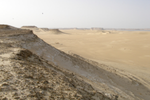
Egypt’s Western Desert, where the Land of the Dead resided for ancient Egyptians.
The First Mummies
Flinders Petrie was an English Egyptologist (June 3, 1853-July 28, 1942) who was working in Egypt attempting to create a chronology of the kings of dynasties 1 and 2. He instituted a practice of paying his Egyptian workers a fair market price for any objects they found and brought to him. As such, while excavating at Abydos, he and his workers discovered the earliest known example of mummified royal remains ever found, that of a first dynasty pharaoh named King Djer. It was a mummified forearm, wrapped in fine linen and still adorned with exquisite bracelets of lapis lazuli and gold. Few mummies of this age remain, as the techniques of the times were not well refined. The bodies were buried in the fetal position and the efforts to preserve the bodies were limited to covering them in linen. Unfortunately, upon the arms delivery to the Cairo Museum, the curator at the time was focused entirely on the jewelry, and the arm and its unique wrappings were discarded. Egyptology has few examples of remains from the first two dynasties and only a handful more from the Old Kingdom (Dynasties 3-6). The goal of the Old Kingdom embalmers was less preservation, more “can we make the body look good for the afterlife?” As such, we see many examples where the body has simply been wrapped in linen and then resin poured over the wrappings and then molded to record the details of the face of the deceased, sometimes including facial hair.
Where it starts to get interesting
In the 4th dynasty we first see the bodies begin to be lain prone, as we are familiar with. There was very little attempt at dehydration throughout the Old Kingdom, leading to large amounts of decay. This is where we do, however, begin to see the removal of the internal organs, with the exception of the heart, for preservation in canopic jars. This shows the first shift away from purely cosmetic concerns to a deeper concern with the reservation of the actual body. The practice of removing the organs and placing them in jars for preservation would continue uninterrupted until the 21st Dynasty. In the beginning the jars were simple, but by the 18th Dynasty they would bear more elaborate lids, often shaped like human heads, and would be inscribed and interred under the magical protection of the four sons of Horus. By the New Kingdom, the jars would bear the heads of the four sons. The canopic jars and preservation of the organs is the first example of the deep and intense ritual that mummification would eventually become.
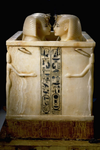
The Canopic Chest of King Tutankhamun housed at the Egypt Museum. It is intricately carved out of alabaster.
With the collapse of centralized power c. 2181 in the First Intermediate Period, things get a little sticky. We again have few mummies from the 7th-11th Dynasties. With the lack of stability, there are no forward advances made with mummification and the next clear indication of change that we can see comes from the Middle Kingdom, the 11th-13th Dynasties, when King Nebhepetra Mentuhotep II re-unified Egypt. We also see significant shifts in religious practices and afterlife beliefs during the Middle Kingdom.
The mummies of the era are not well preserved but show an attempt at increased preservation. Not all mummies had the organs removed, and it seems that they did not remove the brain at all. For the mummies that did have the organs removed, they began to remove the organs through a 7-inch incision along the left side of the abdomen and then the abdominal cavity would then be stuffed with straw. The bodies would be laid prone and wrapped with hand either along the sides or covering the pubic region. An interesting fact about the linen used in the mummification process is that it was generally old sheets ripped into strips and repurposed for the wrapping. This was true for both the lower classes and for the royalty. We also begin to see the use of natron for the first time. Unlike later periods, the natron would be applied to the body post wrapping and when the body was already in the tomb, leading to mediocre levels of dehydration and intense decay.
Getting There
This all leads us to the New Kingdom, three dynasties (18th, 19th, and 20th), and 500 years of good, solid mummification progress all leading us to the 21st Dynasty aka the high point of mummification. Something else that is seen in the New Kingdom is the pillaging and looting of tombs from earlier dynasties. Priests were charged with putting these tombs back in order out of respect for the dead and their afterlives and during this process, for the very first time, they were able to see firsthand the success and failures of earlier mummification. This led to the greatest increase in knowledge and would eventually lead to the golden age of mummification.
There are no mummies from the Amarna Period but the rest of the New Kingdom provides us with a large number of remarkably well-preserved mummies to study. King Tutankhamun and the mummies of his two infant daughters have been studied, and the condition of the remains and the tomb provide a great deal of insight into the changes that were being made even as early as the end of the 18th Dynasty. Part of this is due to the location that the pharaohs of the New Kingdom chose for their final resting place, The Valley of the Kings. A very low humidity section of the desert of the western shore of the Nile across from Luxor, it was a remote and sacred space for the living embodiment of Ra to rest for eternity.
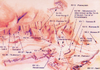
A Map of the Valley of the Kings
During the Middle Kingdom we see the brain beginning to be removed from the cranium. Using a special hooked instrument, the embalmer would go in through the nose, breaking through the ethmoid bone in the sinuses, and pull out the brain. Once the brain was removed, they would often then fill the cavity with strips of linen. The eye sockets were also often stuffed with linen in order to give the face a more lifelike appearance. Resin and linen were used far more liberally in this era as well.
Golden
And finally, the 21st Dynasty. When they finally had it all figured out and all the disparate pieces of the puzzle came together. The dehydration aspect of natron, removing the organs and preserving them individually, and the full culmination of the great rituals. Unfortunately, this golden era of mummification only lasted through the 22nd Dynasty before declining. More than 40 different mummies from the 21st Dynasty have been discovered. And despite all the great and grand discoveries of Egypt, we have never discovered a full text that explains mummification. The papyri we have discovered describe only parts, and what we have shows that embalming was a family affair and that the secrets and practices were likely passed from father to son by word of mouth. The Rhind Papyri, discovered in 1857, describes some of the ritual of embalming, so here is what the Ancient Egyptians did to prepare their loved ones for their great afterlife.
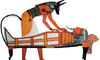
One of the main tasks associated with Anubis was preparing the dead for the afterlife.
The ritual of mummification lasts 70 days and was generally performed outdoors, usually on a hill, where the wind can carry away the odors of death. During that time there were various ceremonies that would take place. Embalming would begin 4 days after death. The organs would be removed and placed in a solution to be preserved before being wrapped. The next 36 days there would be 17 ceremonies, one for each part of the body as the Egyptians saw it:
7 openings of the head
4 sons of Horus (organs)
2 legs
2 arms
1 front torso
1 back torso
17 parts of the whole
The body would also spend at least 36 days immersed in natron, which is a naturally occurring mix of baking soda and salt, to facilitate dehydration. 46 days after death the bandaging would take place. The papyri explains that the head is to be anointed with frankincense and the body with urgent (sacred oil). The back is to be anointed with fat and the skull packed with aromatic spices. It gives explicit details for how to bandage the skull, listing the magical names of each bandage. Then it instructs how to soak a bandage in resin to finish off the skull. It provides similar instruction for the hands, feet, legs, and torso. Lastly it details the “Opening of the Mouth” ceremony, the last ceremony before burial, where a priest symbolically opens the mouth of the deceased so that they can breathe in the afterlife.
Now, in the New Kingdom, the organs were often replaced into the abdominal cavity instead of placed into the canopic jars. The canopic jars were still present in the burials, and were at their most symbolic and ritual at this point. Each jar represents a son of Horus and each lid was shaped like one of their heads: Imsety (human), protector of the liver; Hapy (baboon), protector of the lungs; Duamutef (Jackal), protector of the stomach; and Qebhsenuef (falcon), protector of the intestines.
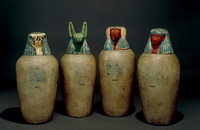
A Set of New Kingdom Canopic Jars on display at the British Museum (registration number 1929,0209.4)
The organs being left in the body meant that the abdomen would have a full and life-like appearance. There are also examples of false eyes being created or of the skin being packed with a fat and baking soda mixture to ensure that robust visage. The faces of male mummies were often painted red and females yellow, emulating the colors used in the tomb paintings.
The Decline
After the 22nd Dynasty the quality of mummification declined to the point where embalmers were creating false mummies to give to people, to be buried in place of their loved ones. Embalmers reverted to prioritizing the external appearance of the body over internal preservation. The organs were still removed, but the brain was left in situ, and they relied on the resin to protect the body from decay. Under the Greeks during the Ptolemaic Dynasties strips of linen specifically for embalming and mummification were produced for the first time, with finished edges and a set width. This allowed the embalmers to create an illusion of depth while wrapping, with squares within squares.
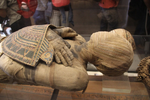
Ptolemaic Era mummy known as Bashiri, who is housed at the Louvre Museum in Paris, France.
Once Rome gained control of Egypt, they continued to allow the tradition to continue, adding in their own flair to it. Romans introduced a realistic portrait of the deceased that was fashioned into a mask and then fastened over the face of the deceased. Inspired by the ancient mummy mask, these portrait masks were often fashioned out of discarded papyri and molded like paper mâché, plastered white, and then painted. Often the papyri is more valuable than the mask, so many Egyptologists take them apart to attempt to read the papyri. Since the stylized masks were often not a true portrait, many romans added in a more realistic one, which are considered by many to be the first true portraits. Most of these have been found in the area around the Fayoum and are thus known as the Fayoum Portraits. Most date from the first two centuries CE. Almost all are painted on rectangular cedar or cypress boards over a layer of white gesso.
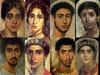
The Fayoum Portraits from the British Museum.
The Romans employed several different bandaging methods, but the most elaborate style was one in which the bandages were crisscrossed diagonally to form numerous squares. The practice of mummification was eventually banned by Emperor Theodosius II in 392 CE.
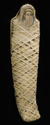
An example of a Romano-Egyptian Mummy housed at the Royal Ontario Museum.
In today's day and age, mummification is no longer a valid option for interment. I know, I know. A large disappointment to many of the readers, I’m sure. And while the Egyptians mummified themselves, their loved ones, their pets, and many and varied wild animals, I would not suggest trying this yourself at home. It would be very messy and time consuming, and I don’t think your HOA would approve.
